BDSM Challenges for Couples: 8 Complete 7-Day Challenges
Looking for a BDSM challenge to try with your partner?
Below are eight complete seven-day challenges, with a different assignment for every day. You can choose a week focused on service, obedience, devotion, protocol, control, honest submission, long-distance D/s or humiliation.
Each challenge tells you what to discuss before you begin, what to do each day and how to adjust it if you want something less intense.
You do not need to follow every instruction exactly. Choose a challenge that interests both of you, agree on your limits and change anything that does not fit your relationship.
These eight are written for any pairing. If the Dominant is a woman and the submissive is a man, the 7-Day Femdom Challenge is one complete week written specifically for that dynamic.

Before You Begin
Do not use a challenge to introduce seven days of activities you have never discussed.
Before the first assignment, agree on:
- The purpose: What do you want to feel, learn or change?
- The authority: What may the Dominant decide, and what remains outside the challenge?
- The limits: Which activities, words, settings and forms of proof are allowed?
- Real-life boundaries: Account for work, sleep, health, disability, privacy and other responsibilities.
- How either person can pause:A safeword can help, but plain language such as “I need to stop” must always be allowed.
- What happens if a day is missed: You might repeat, replace or simply discuss the assignment.
- What remains private: Never involve an unaware person or require photographs or recordings that create an unacceptable privacy risk.
Agreeing to the challenge does not mean agreeing to every possible version of it. Consent remains specific and reversible. Either person can stop or change an assignment. If you have not already set out how you negotiate limits and safewords together, do that before the first day rather than during it.
If something is new, begin with the least intense version. The goal is to explore, not to make every day harder until somebody breaks.
Choose Your 7-Day BDSM Challenge
You do not need to complete all eight. One challenge that fits your dynamic is enough.
Challenge 1: Seven Days of Service
This challenge is for couples who want service to feel like more than a chore list.
Each assignment should teach the submissive something about the Dominant's real preferences, standards or needs. By the end, you should know which acts feel meaningful and which only create more work.
Agree beforehand
Choose where service is welcome. Discuss budget, personal belongings and anything the submissive should never reorganize, discard or decide without asking.
Day 1: Learn the preference
The submissive asks the Dominant to choose one ordinary activity: making coffee, preparing for bed, packing a bag or resetting a workspace. They learn exactly how the Dominant prefers it done, including details that usually go unspoken.
Day 2: Follow the standard
The submissive performs yesterday's service as instructed. When finished, they present the result and ask for approval instead of assuming it was done correctly.
The Dominant gives one specific piece of recognition and, if needed, one useful correction.
Day 3: Remove a burden
The Dominant assigns one bounded task that will genuinely make their day easier: complete an errand, research a purchase, prepare something needed later or handle an agreed household task.
Busywork does not become meaningful just because a Dominant assigned it.

Day 4: Serve with presence
Repeat a familiar service, but give it a clear beginning and end. The submissive might ask permission to begin, wear their collar, present the finished work, kneel for feedback or use the Dominant's title.
Notice whether the ritual makes the service feel more submissive or merely more complicated.
Day 5: Anticipate within limits
The submissive identifies one need before being directly instructed and proposes the service they believe would meet it. The Dominant may approve, alter or decline the proposal.
Anticipatory service is not mind reading. Asking first is better than creating a surprise the Dominant never wanted.
Day 6: Meet a higher standard
The Dominant chooses one service from the week and raises the standard in a specific way: earlier completion, more careful presentation, better attention to detail or a more formal report. The requirement should be clear enough that the submissive knows what excellence looks like.
Day 7: Choose what continues
The submissive performs the service that felt most significant during the week. Afterward, each partner names:
- the service that felt most meaningful;
- the service that felt most burdensome;
- the kind of recognition or correction that worked best; and
- one service, if any, they want to make recurring.
Lower-intensity version: Keep every assignment nonsexual, at home and under 20 minutes.
Challenge 2: Seven Days of Obedience
Obedience requires clear instructions. The submissive should know what to do, when to do it and how the Dominant will judge it.
This challenge practices the full process: command, acknowledgment, completion, reporting and response.
Agree beforehand
Choose when assignments may be given, which responsibilities override an order, how the submissive should raise a conflict and whether correction or consequences are part of the week.
Day 1: One clear instruction
The Dominant gives one simple instruction: what must be done, when it is due and how completion should be reported.
The submissive acknowledges it in the form the Dominant chooses, completes it and reports back without needing to be chased.
Day 2: Attention to detail
The Dominant gives an instruction containing three deliberate details: perhaps the time, the order of actions and the required form of proof. The submissive repeats the instruction back before beginning, then follows it exactly.
This tests listening, not endurance.
Day 3: Obey at an inconvenient moment
The Dominant gives a previously agreed, low-effort command during a defined window. The submissive pauses what they are doing when safely able, completes it and returns to their day.
The interruption creates the feeling of obedience. It should not disrupt work, driving, sleep or another real responsibility.
Day 4: Ask correctly
The submissive must request permission for one preselected, low-stakes choice: what to wear at home, when to take a leisure break, which entertainment to choose or another category that fits the relationship.
The Dominant gives a real answer rather than approving automatically.
Day 5: Receive correction
The Dominant assigns a task with a known standard, such as a written response, a presentation position or a prepared space. If something needs improvement, the Dominant identifies it specifically and the submissive repeats or corrects the work without arguing against a standard they previously accepted.
Correction should improve performance. Do not manufacture failure just to create a reason for displeasure.
Day 6: Hold the instruction
The Dominant gives an instruction in the morning that must be remembered and completed later without another reminder. The submissive records it somewhere private if needed; using a system is not less obedient than relying on memory.
Day 7: Demonstrate what was learned
The Dominant selects one form of obedience practiced during the week and asks the submissive to perform it again with no additional coaching. Afterward, they review which part of the loop was strongest and where clarity broke down.
Lower-intensity version: Use only ordinary daily actions and no punishments. The challenge still works because the power exchange comes from who decides and who follows.
Challenge 3: Seven Days of Devotion
Devotion may be reverent, romantic, erotic, possessive or deliberately unequal. What matters is that each act is personal to this Dominant, not generic praise that could be sent to anyone.
Agree beforehand
Discuss what words such as devotion, worship, ownership and surrender mean in your relationship. Choose language that feels powerful to both of you rather than borrowing titles or declarations that do not fit.
Day 1: Name what is being offered
The submissive writes a short statement beginning, “For the next seven days, I offer you…” They name the attention, service, obedience, honesty or restraint they intend to practice.
The Dominant responds by naming what they accept and what responsibility they take for directing it.
Day 2: Create a private symbol
The Dominant chooses a discreet symbol of the dynamic for the submissive to wear or carry: a collar, ring, color, item of underwear, written word or another private marker. The submissive puts it on with intention and acknowledges what it represents.
Day 3: Study the Dominant
The submissive records five specific preferences, habits or qualities they have noticed about their Dominant. At least two should be details that help them serve or understand the Dominant better, not generic praise.
Day 4: Speak the devotion
The submissive speaks for two uninterrupted minutes, in person or by voice note, about what draws them to submit to this person. The Dominant listens without making a joke or immediately demanding more.
Day 5: Make an offering
The submissive creates or prepares something chosen for the Dominant: a meal, letter, photograph, playlist, polished item, planned evening or act of erotic service already within their agreements. The offering should reveal knowledge of the recipient.
Day 6: Wait for attention
During an agreed period, the submissive makes themselves available in a chosen way without demanding immediate acknowledgment. They may kneel, remain in a presentation position, send a message and wait, or prepare themselves for the Dominant's arrival.
Set a maximum time beforehand. Waiting can create tension. Being forgotten does not.
Day 7: Be recognized
The Dominant tells the submissive what they noticed during the week: where devotion felt genuine, what affected them and what they want to receive again. The submissive listens without deflecting the recognition.
End by choosing one small devotional act to repeat. Keep it because it earned a place, not because a complete dynamic needs another rule.
Lower-intensity version: Keep the entire challenge symbolic and verbal, with no ownership language or sexual service.
Challenge 4: Seven Days of Protocol
Protocol turns preferences into repeated behavior. It can shape speech, posture, greetings, movement and presentation.
The goal is not to collect rules. It is to find a few behaviors that make the Dominant's authority visible and the submissive's role physical.
Agree beforehand
Choose whether each protocol applies in private, at home, during scenes or in selected public settings. Keep public protocol discreet and do not involve unaware people.
Adapt every position and movement to the submissive's body. Pain, dizziness or instability is not failed protocol.
Day 1: Choose the forms of address
Agree on the Dominant's title, when it is required and what the submissive says if using it would expose the dynamic. Practice several ordinary exchanges until the title feels intentional rather than inserted at random.
Day 2: Establish a greeting
Create a private greeting for arriving home, beginning a call or entering a period of D/s. It may include posture, eye contact, a phrase, presenting the collar or waiting for acknowledgment.
Perform it once, correct what feels awkward and perform it again.
Day 3: Practice one position
The Dominant chooses one standing, seated, kneeling or presentation position. They define the placement of the submissive's hands, gaze and body. The submissive practices entering, holding and leaving it smoothly.
Precision matters more than duration.

Day 4: Add a response protocol
Choose how the submissive acknowledges an instruction, asks for clarification and reports completion. Practice all three with real but low-stakes instructions.
A protocol that leaves no acceptable way to ask a question is badly designed.
Day 5: Move together
Practice one protocol involving movement: where the submissive walks, who enters first, how they follow a gesture, where they wait or how they approach when called. Use it only in an appropriate private or kink-aware setting.
Day 6: Combine the pieces
Use the title, greeting, position and response protocol during one defined hour or evening. The Dominant corrects only what matters; constant interruption can destroy the headspace the protocol was meant to create.
Day 7: Formal inspection
The submissive presents each element learned during the week. The Dominant inspects, corrects and approves the final form. Together, remove anything that felt theatrical without feeling meaningful.
Write down the protocols you are keeping, including when they do and do not apply.
Lower-intensity version: Choose only a title, greeting and completion response. Three well-kept protocols can carry more weight than fifteen forgotten ones.
Challenge 5: Seven Days of Control
Control works best when both people know exactly where it begins and ends.
Choose one or two low-risk parts of daily life and place them under the Dominant's authority for a week. Options include clothing at home, bedtime routine, leisure, meals within established dietary needs, grooming, masturbation or a small agreed personal budget.
Do not include essential medication, access to food or water, necessary sleep, medical care, work obligations, contact with support systems or financial decisions that could cause real harm.
Agree beforehand
Name the controlled categories in writing. Also name what is excluded, how quickly the Dominant must respond to requests, what happens when they are unavailable and how the submissive can reclaim a decision when circumstances change.
Day 1: Surrender one choice
The Dominant makes one choice in the selected category. The submissive follows it and later describes what changed when an ordinary decision no longer belonged to them.
Day 2: Ask permission
The submissive requests something they would normally decide without consultation. The Dominant considers the request and chooses yes, no or an alternative. The answer should be consequential enough to feel real but safe enough to hold without resentment.
Day 3: Follow a restriction
The Dominant removes one option for a defined period: no social media for an hour, no choosing the evening's entertainment, no changing out of an assigned outfit at home, or no sexual release within an already negotiated orgasm-control agreement.
Define the start and finish. “Until I remember” is not a structure.
Day 4: Let the Dominant plan
The Dominant plans one bounded section of the submissive's day. They account for the submissive's actual schedule and needs rather than treating inconvenience as proof of authority.
The submissive follows the plan without renegotiating every preference along the way.
Day 5: Carry the control privately
The Dominant chooses a private rule the submissive must remember while moving through an otherwise ordinary day. It might concern clothing, posture, a word they may not use, a private check-in or an action they must take before a chosen activity.
No one outside the relationship should be made part of enforcing it.
Day 6: Receive a deliberate denial
The submissive asks for something they genuinely want within the chosen category. The Dominant denies or delays it for a specific reason and duration, then observes how the submissive handles the answer.
Denial is not permission to withhold basic care, affection needed for emotional safety or communication about the relationship.
Day 7: Return the authority
At a stated time, the Dominant formally returns the controlled choices. Discuss which decisions created erotic or emotional charge, which created needless administrative work and whether any authority should continue.
Lower-intensity version: Control one decision per day instead of an entire category.
Challenge 6: Seven Days of Honest Submission
Submission can make someone highly visible while still leaving important things unsaid.
This week focuses on desire, resistance, pride and fear. The Dominant's job is not merely to demand honesty. It is to make honesty safe enough to give.
Every day here is a writing assignment, so it pairs naturally with BDSM journaling.
Agree beforehand
Either partner may decline a specific prompt. Decide which entries will be shared, whether the Dominant may comment immediately and what information must never be recorded digitally.
Day 1: What submission gives me
The submissive writes about what they receive from submission. Relief, arousal, structure, intimacy, recognition, usefulness and escape are all possible; none is required.
The point is not why submission should matter. It is why this person returns to it.
Day 2: What I perform
The submissive names one behavior they perform because it looks submissive even though it does not mean much to them. They explain what they would prefer instead.
Day 3: What I resist
The submissive names an instruction, rule or kind of surrender that creates resistance. They distinguish among playful resistance, erotic reluctance, ordinary annoyance, fear and a genuine boundary.
The Dominant does not punish the disclosure.
Day 4: What I want but rarely request
The submissive describes one experience, feeling or form of attention they want more of. Specificity matters: “more dominance” is less useful than “choose what I wear when we go out together” or “make me wait before you touch me.”
Day 5: What the Dominant carries
The Dominant writes or speaks about one responsibility, uncertainty or desire connected to leading the dynamic. The submissive receives the truth without treating vulnerability as loss of authority.
Day 6: The difficult fantasy
The submissive describes a fantasy they find difficult to disclose. They may write the complete fantasy or focus on the emotional element that makes it compelling. Sharing a fantasy does not request or authorize its enactment.
The Dominant responds first with what they understood, rather than giving an immediate verdict or plan.
Day 7: What I understand now
Each partner answers three questions:
- What did I learn about you this week?
- What do I want to ask more about?
- What, if anything, should change in our dynamic?
Choose one conversation to continue after the challenge. Not every disclosure needs to become a rule, task or scene — some of them simply need a better conversation than the one you have been having.
Lower-intensity version:Replace the difficult-fantasy prompt with “a moment when I felt especially connected to my role.”
Challenge 7: Seven Days of Long-Distance Submission
Distance removes many of the physical cues that make D/s feel immediate. More messages are not always the answer. A few well-designed moments of authority can do more.
For a Mistress leading from a distance, there is a full guide to 35 long-distance femdom ideas. And if a missed assignment also needs a consequence that still works through a screen, there is a separate guide to 35 long-distance punishment ideas.
Agree on realistic response windows. Someone who is asleep, working or in another time zone is not disobedient because they cannot perform on demand.
Agree beforehand
Set communication windows, acceptable forms of proof, data-storage expectations and a backup plan if either person loses access to their phone. Never require identifiable intimate media merely to prove commitment.
Day 1: Begin and end under instruction
The Dominant assigns a short morning action and evening action. The submissive completes each at the appropriate local time and reports in the agreed form.
The two actions should bookend the day without requiring constant contact between them.
Day 2: Wear something chosen
The Dominant chooses an item, color, accessory or layer for the submissive to wear. It can be completely discreet. The submissive sends a written confirmation or a privacy-safe photograph if that has been agreed.
Day 3: Complete remote service
The submissive performs something genuinely useful from a distance: research a date or trip, organize a shared plan, proofread something, prepare a playlist, place an agreed order or remove a small piece of work from the Dominant's day.
Day 4: Respond to the voice
The Dominant records an instruction as a voice note. The submissive listens at the agreed time, follows it and replies by voice. Tone, pauses and form of address can carry parts of the dynamic that text loses.
Day 5: Wait
The Dominant gives the submissive a preparation instruction and a defined window in which they must wait for the next message. The submissive may be told how to dress, where to sit, what to have ready or what they may not do while waiting.
Set an end time even if the follow-up message fails to arrive.
Day 6: Be observed without explicit media
The Dominant chooses one part of the submissive's day to make visible through a check-in, completed-task record, journal entry, timer, voice note or photograph that reveals no more than both people want stored.
Proof should serve the dynamic. It should not become surveillance.
Day 7: Share live time
End with a call or live exchange in which the Dominant directs a short ritual, inspection, service, scene or review already within the couple's agreements. Then discuss which remote interactions created presence and which merely created phone administration.
Choose one remote ritual to keep.
Lower-intensity version: Use only text, voice and non-intimate photographs. No live scene is necessary.
Challenge 8: Seven Days of Humiliation
Humiliation is personal. A word that creates the right kind of shame for one submissive may leave another cold and genuinely hurt a third.
So this challenge does not simply provide seven insults. Begin by identifying what the submissive actually finds humiliating: embarrassment, objectification, confession, inspection, reduced status, imperfect performance, sexual shame or being made to admit something they would rather hide.
This challenge is for partners who already know they share an interest in humiliation. It is not a way to surprise someone with it. For a menu of scenes to draw the seven days from, see 38 humiliation ideas for subs.
Agree beforehand
Create three lists:
- Wanted: words, themes and situations the submissive actively wants;
- Uncertain: material that requires caution or a lighter first attempt; and
- Excluded: identities, insecurities, experiences and real-life vulnerabilities that must not be used.
Also decide whether the humiliation stays private, whether recordings are allowed, what stop signal works if the submissive is expected to appear reluctant or remain silent, and what kind of reassurance or aftercare may be needed.
Day 1: Name the shame
The submissive completes the sentence, “I want you to make me acknowledge…” They identify one desire, behavior, role or fantasy they want brought into the open.
The Dominant chooses language from the wanted list and gives it back to them as a statement or question. The purpose is recognition, not escalation.
Day 2: Controlled embarrassment
The Dominant assigns a private act that makes the submissive feel exposed without attacking a real vulnerability. Examples include adopting an undignified pose, reading an approved confession aloud, asking for something in deliberately embarrassing language or presenting an item associated with the submissive's kink.
Day 3: Inspection
The submissive presents their body, clothing, grooming, posture or completed work for inspection. Beforehand, specify what may be examined, touched and commented upon. The Dominant makes the submissive wait for the final judgment instead of offering instant reassurance.

Day 4: Reduced status
For a defined private period, the Dominant assigns a role that places the submissive below their ordinary standing: servant, pet, doll, object, applicant, specimen or another negotiated identity.
Give the role behavioral rules. A label without conduct rarely creates much headspace.
Day 5: Recorded confession
The submissive records an approved statement about what they want, what they have done, how they see their role or what the Dominant is permitted to call them. Decide whether the recording is kept, deleted after viewing or never shows the submissive's face.
Do not create intimate material whose privacy risk outweighs its value.
Day 6: Perform under observation
The Dominant assigns a private performance: posture practice, a striptease, service, reciting rules, demonstrating a position or another agreed act. The submissive knows they are being watched and evaluated. The Dominant may interrupt with approved corrections or commentary.
Day 7: Put the week into words
The Dominant tells the submissive what they revealed during the challenge and which moments made their submission most visible. The submissive describes which humiliation created desired shame, which missed completely and whether any part reached somewhere it should not have.
End the role clearly. Provide the form of aftercare the submissive has asked for, which may include affection, praise, ordinary conversation, physical closeness, space or a next-day check-in.
Lower-intensity version: Keep every act private, verbal and free of permanent recordings. Use embarrassment and inspection without insults or degradation.
How to Make Any BDSM Challenge Fit Your Dynamic
The assignments above are starting points. Before using one, make five decisions together.
1. Define what the challenge is meant to create
“More submission” is too vague.
You might want the submissive to feel watched throughout the day, help the Dominant become more comfortable giving direct instructions, make service more personal, practice protocol before an event, or finally speak openly about humiliation.
Once the purpose is clear, remove anything that does not support it.
2. Decide what progress means
Finishing every assignment is not the only measure of success. You may discover a ritual worth keeping, learn that a fantasy works better in imagination, uncover an unclear boundary or find the kind of instruction that makes the submissive feel claimed.
3. Match the assignment to the person
A service submissive may respond deeply to preparing one cup of coffee exactly as their Dominant wants it. The same assignment may feel like empty housework to someone whose submission centers on restraint, humiliation or sexual control.
The same task can feel deeply submissive to one person and meaningless to another.
4. Give the Dominant work too
A challenge is not seven assignments dropped into the submissive's inbox.
The Dominant must notice, respond, correct, make decisions and remain available for the authority they have chosen to exercise. If the Dominant has no capacity to review five paragraphs of journaling every night, they should not request five paragraphs. If they will not remember a restriction, they should not impose it.
When the Dominant does not respond, submission starts to feel like administration.
5. Close the challenge deliberately
At the end, ask:
- Which day affected you most?
- Which assignment felt least connected to our dynamic?
- What did you learn about what I want?
- What did you learn about what you want?
- Is there anything we should repeat, change or never do again?
A challenge needs an ending even when one of its practices continues.
Run Your Challenge in Collared
You can run these challenges with messages, paper or a shared note. The relationship matters more than the software.
If you want the structure kept in one place, Collared lets a Dominant create the seven assignments in advance, choose the day each is due and add instructions or reminders. The submissive sees what is expected each day and can report completion without the Dominant having to reconstruct the week from a message thread.
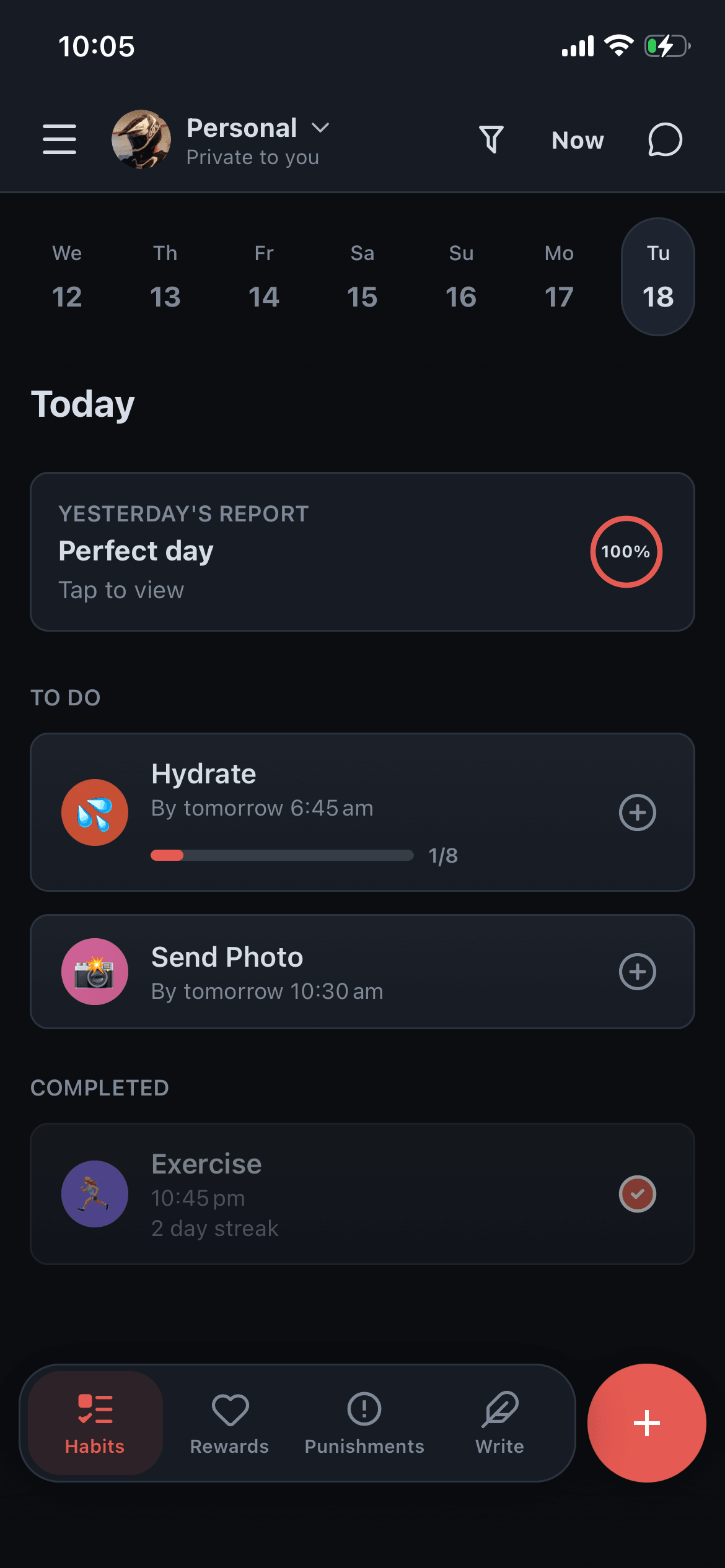
Depending on the challenge, you can use:
- One-time tasksfor each day's assignment;
- Habits for an action repeated throughout the week;
- Photo proof when both partners want visual verification;
- Notes and chat for instructions, questions and feedback;
- The BDSM Journal for reflections, confessions and the final review; and
- Rewards and punishments if those systems already belong in your dynamic.
You can also browse Collared's library of 282 submissive tasks when you need to replace an assignment with something that better fits your relationship.
To pick a week that matches what the submissive partner has actually done before, take the Submissive BDSM Test first and compare the categories that score highest.
Collared does not decide what your challenge should contain. It gives the agreements you make somewhere private to live.
Frequently Asked Questions
What is a BDSM challenge?
A BDSM challenge is a set of negotiated activities completed over a fixed period to explore one part of a BDSM or D/s dynamic. Unlike unrelated dares, the activities share a purpose and end with a review of what you learned.
How long should a BDSM challenge last?
Seven days is long enough to create continuity without requiring a major commitment. A simple ritual can be explored for longer, while an emotionally or physically intense challenge may need fewer active days and more time for recovery. Longer is not automatically deeper.
Are these BDSM challenges suitable for beginners?
The service, devotion, honest submission and lower-intensity obedience challenges can work for beginners when every activity is discussed first. Protocol, control and humiliation require more specific negotiation. Beginners should remove anything unfamiliar rather than treating completion as a test of whether they are truly dominant or submissive.
What happens if the submissive misses a day?
Use the agreement you made before beginning. You might repeat the assignment, move it to another day, replace it, discuss why it did not happen or continue without it. A missed day can reveal an unrealistic expectation, unclear instruction, avoidance, ordinary life interference or deliberate disobedience; those situations should not automatically receive the same response.
Does a BDSM challenge need rewards or punishments?
No. Some dynamics use rewards, punishment or points, while others value praise, approval, ritual, attention or the experience itself. Add a consequence system only if it already has meaning for you. Do not bolt one on because a challenge is supposed to feel like a game.
Can long-distance couples do a BDSM challenge?
Yes. Choose assignments that work through text, voice, video, journaling, remote service, scheduled rituals or privacy-safe proof. Agree on time zones and response expectations, and do not mistake constant availability for submission.
Can a submissive propose the challenge?
Yes. A submissive can disclose what they want to experience and invite the Dominant to shape or lead it. Knowing what a submissive wants does not make the resulting authority less real; it gives the Dominant better material to work with.
Should every day become more intense?
No. Escalation is only one possible structure. A challenge may deepen through greater specificity, vulnerability, precision or meaning rather than harsher activity. Some of the strongest final days are about recognition and integration, not intensity.
Give the Week a Purpose
The best BDSM challenge is not the hardest one. It is the one that makes something between you clearer.
Perhaps the submissive learns that being inspected affects them more than being punished. Perhaps the Dominant discovers that giving precise instructions feels better than setting broad rules. Perhaps an act of service becomes a ritual, a humiliation fantasy becomes speakable, or seven days of remote submission gives a long-distance relationship a rhythm it was missing.
Choose one purpose. Put it under deliberate attention for a week. Then keep only what earns its place in your dynamic.
Start Your First Challenge
Create the seven assignments, schedule each day and keep the whole challenge inside your shared D/s space. Try Collared free on iOS or Android.